
Follow us
Latest News & Events


“The Doctor’s Doctor”: How Pathology Departments are Advancing Medical Diagnosis through Digitalization and AI
I. Pathology: The “Gold Standard” for Cancer Diagnosis and Current Challenges
Pathologists, known as “the doctor’s doctor,” do not typically interact with patients directly. Instead, they provide pathological diagnosis reports by analyzing patient tissue samples and pathology slides. This report is the ultimate and most reliable basis for clinicians to formulate treatment plans (e.g., surgery, chemotherapy, or targeted therapy).
Academician Zhong Nanshan of the Chinese Academy of Engineering emphasized, “The level of clinical pathology is an important indicator to measure the quality of national medical care.”
1. Case Focus: How Accurate Pathological Diagnosis Saves Lives
The personal experiences of Professor Wang Chaofu, Director of the Pathology Department at Ruijin Hospital, deeply illustrate the value of precise pathology diagnosis:
- Discovery of a New Renal Cancer Type: In 2010, Professor Wang suspected a renal tumor was not benign, despite the initial diagnosis. It was later confirmed as a new type of renal cell carcinoma, with only 17 cases reported globally at the time.
- Preventing Amputation: In 2016, a young woman diagnosed with bone cancer and facing amputation had her diagnosis corrected to myositis ossificans (a benign lesion) after consultation with Professor Wang, saving her leg.
2. Resource Shortage and Workflow Bottlenecks
Despite the critical nature of their work, pathology departments in China face significant hurdles:
- Talent Gap: With less than 20,000 registered pathologists, there is a shortage of 140,000.
- Uneven Distribution: Top pathology experts are concentrated in a few elite hospitals, leaving grassroots hospitals with weak diagnostic capabilities.
- Traditional Slide Limitations: Glass slides are difficult to store long-term (prone to fading, damage, and loss), and inefficient information management (e.g., handwritten labels) limits sample tracking and research.
Ruijin Hospital’s Pathology Department generates over a million slides annually. This massive workload urgently requires a digitalization solution to “reduce the burden” and boost efficiency.
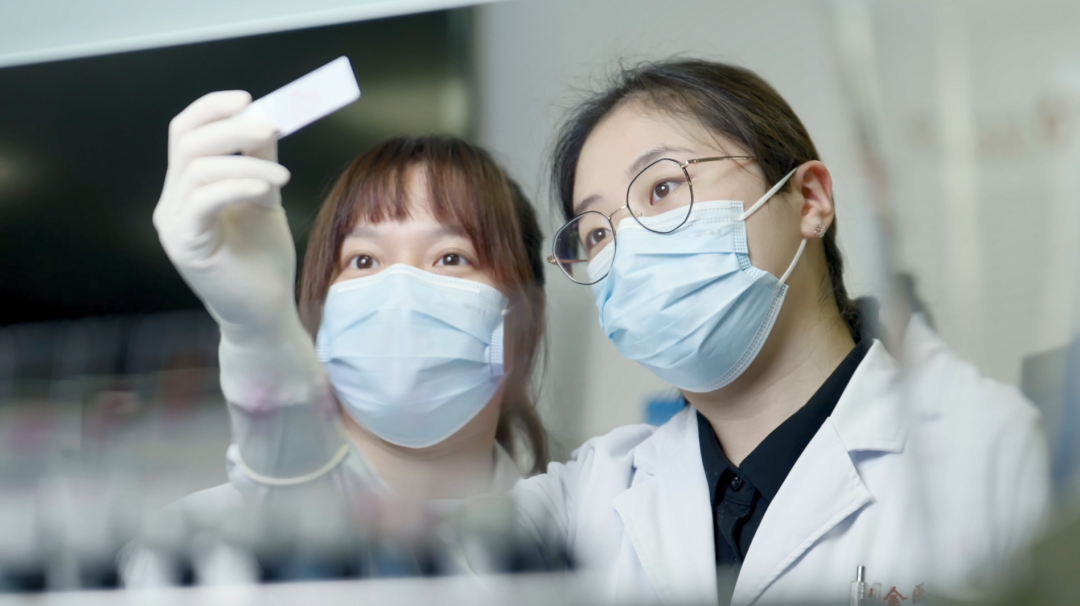
II. The Digital Transformation: The Promise of Digital Pathology and AI Medicine
The introduction of Digital Pathology Systems offers a targeted solution to the pain points of traditional pathology. The system converts physical slides into Digital Slides (Whole Slide Imaging, WSI) through scanning, bringing revolutionary advantages:

| Advantage | Problem Solved |
| Data Preservation | Precious pathology data can be preserved permanently, solving the issues of difficult storage and retrieval of glass slides. |
| Remote Consultation | Doctors can view digital slides anytime, anywhere, at different magnifications. Easy sharing facilitates telemedicine and cross-regional consultation. |
| Education & Training | Supports online slide reading webinars and live teaching, which is crucial for training more pathology talent. |
| AI Enablement | Digital slides are the foundation for AI pathology analysis, helping doctors enhance reading efficiency and diagnostic accuracy. |
III. 🚀 1000 Slides/Second Access: High-Performance Storage Fuels Digital Pathology
While Digital Pathology is highly beneficial, it presents challenges in massive data storage and high-performance access. A single digital slide can be the size of an HD movie, with hospitals generating hundreds to tens of thousands daily. Traditional IT infrastructure struggles with:
- High access delays, system freezes, and “mosaics” that severely affect reading speed and accuracy.
- Extremely high requirements for long-term storage, computer room space, and backup solutions.
- Concerns over data confidentiality, sharing, and external hacker attacks.
Huawei OceanStor Pacific: A Breakthrough Solution at Ruijin Hospital
To overcome these digital pathology data challenges, Ruijin Hospital’s Pathology Department partnered with Huawei Data Storage, leveraging the Huawei OceanStor Pacific distributed storage solution to achieve a qualitative leap in performance:
- Ultra-Fast Access: Huawei distributed storage enables the simultaneous access of 1,000 slides in one second, surpassing traditional storage performance by over 80 times. This ensures real-time, smooth slide viewing for clinical, research, and teaching staff.
- Data Reduction and Space Efficiency: Huawei’s unique secondary compression algorithm for digital pathology achieves a compression ratio of over 30%. Combined with the high-density hardware design of OceanStor Pacific, the hospital saved 73% of computer room space, significantly reducing long-term storage costs.
Conclusion: The integration of medicine and technology, particularly the application of Digital Pathology and AI in the pathology department, is the crucial path to addressing uneven medical resources and improving the overall quality of national healthcare. By securing the fast and safe flow of massive pathology data through high-performance storage technology, the expertise of pathology specialists can be extended to benefit a far greater number of patients.

Written by : Wang, Sibo
2 Comments
Leave a Reply
Recommend products
Here we recommend you popular products


Recommend products
Here we recommend you popular products
Connect With Our Experts Now
If you have any suggestilons and comments on our productsand servlces, please fill in the following table
Events
Connect With Our Experts Now
If you have any suggestilons and comments on our productsand servlces, please fill in the following table
Events



Download Product Information
Fill in the following information to download the detailed information of this product
Product Enquiry
Fill in the following information to send your inquiry
Greetings Dear,
I hope this email finds you well.
We are interested in procuring your products and I only got limited info form your platform.
Could you please provide us with the following,
– Product Catalog
– MOQ
– Production Time and Lead schedule
– FOB (Free on Board) terms
I await your swift response.
Regards
Dear Omar Ibrahim, please provide an e-mail. We’ll contact you soon.